
World Junior Badminton 2026: India, the 3x55 Format and a Test Without a Home Crowd
**Câu trả lời cốt lõi**: Ấn Độ công bố đội hình 18 vận động viên cho Giải Vô địch Cầu lông Trẻ Thế giới 2026 tại Cairo (5-17/10/2026), do Tanvi Patri, Shaina Manimuthu và Dev Ruparelia dẫn dắt. Giải lần đầu áp dụng thể thức 3x55 ở nội dung đồng đội Suhandinata Cup và 3x15 ở nội dung cá nhân Eye Level Cups. Ấn Độ là hạt giống số 5. **Dữ kiện chính**: - Đội hình 18 người trải đủ 5 nội dung; Yogansh Singh và Aanya Bisht đánh hai nội dung mỗi người. - Ấn Độ nằm bảng D1 cùng Peru và Brazil; phải thắng play-off trước đội nhất bảng D2 (Indonesia, Macau Trung Quốc, Senegal). - Indonesia là hạt giống số 9, chỉ cách Ấn Độ bốn bậc hạt giống. - Vòng tuyển chọn BAI diễn ra 18-21/9/2026; trại huấn luyện 25/9-2/10/2026 tại Guwahati. - Năm 2025, Ấn Độ giành huy chương đồng đồng đội và bạc cá nhân, tổ chức tại Guwahati. **Nguồn**: Khel Now, bản tin công bố đội hình, tháng 9 năm 2026. **Hỏi đáp liên quan**: Q: Thể thức 3x55 ở nội dung đồng đội hoạt động ra sao? A: Cơ chế chính xác chưa được định nghĩa trong bản công bố, cần đối chiếu tài liệu chính thức của Ban điều hành BWF. Q: Vì sao hạt giống số 5 của Ấn Độ chưa bảo đảm suất vào tứ kết? A: Ấn Độ vẫn phải thắng trận play-off loại trực tiếp, nhiều khả năng gặp Indonesia, trong thể thức mới có phương sai cao. Q: Danh hiệu U17 châu Á của Tanvi Patri có dịch chuyển trực tiếp thành thành tích U19? A: Không tự động; U17 và U19 là hai nhóm tuổi khác nhau với yêu cầu thể lực và đối đầu khác nhau, theo dữ liệu hiện có.
Eighteen athletes. Five disciplines. Two scoring formats that have never been used at any junior championship. And a seeding gap of just four places between India and Indonesia — two teams that will be forced to look at each other if both do their jobs in the group stage.
Those were the first lines I underlined when I read the Badminton Association of India's squad announcement for the 2026 BWF World Junior Championships, held in Cairo, Egypt, from October 5 to 17, 2026. The release puts Tanvi Patri, Shaina Manimuthu and Dev Ruparelia front and centre. Most reports will stop there — at the names, at the medals already won, at the optimistic tone of the federation. But what made me reopen my spreadsheet was not a name. It was the numbers 55 and 15, and the gap between Guwahati in 2026 and Cairo in 2026.
I have worked in this trade since 2026, after I called a Manchester derby wrong because I trusted reputation instead of indicators. Emotion is a low-quality data point. I paid to learn that. Since then, whenever a sports federation publishes a squad, I skip the praise. I read the list, the schedule, the format, and the places where the press officer accidentally reveals the real structure of the problem.
Context: a squad balanced to the point of suspicion
India brings eighteen athletes to Cairo, allocated with a very clear logic. Four men's singles players: Nishchal Chand, Dev Ruparelia, Jagsher Singh Khangurra and Akhil Reddy Bobba. Four women's singles players: Parul Choudhary, Tanvi Reddy Andluri, Shaina Manimuthu and Tanvi Patri. Two men's doubles pairs: Aathish Sreenivas P.V. with Yogansh Singh, and Pavan Suresh with Punith Suresh. Two women's doubles pairs: Aanya Bisht with Angel Punera, and Diya Bheemaiah B. with Baruni Parshwal. Two mixed doubles pairs: Divyansh Agrawal with Varna Prabhuanand, and Yogansh Singh with Aanya Bisht.
That structure is not accidental. Four singles slots per gender, two pairs per doubles discipline, two mixed pairs — that is the standard shape of a squad built for the Suhandinata Cup, the mixed-team event of the World Junior Championships. This is a team-event-first, individual-event-second roster. That is a strategic choice, not a random one.
But two names deserve to be pulled out of the block: Yogansh Singh and Aanya Bisht. Singh plays both men's doubles and mixed doubles. Bisht plays both women's doubles and mixed doubles — and she was part of the squad that won a historic medal last year. Two athletes, three disciplines, one thirteen-day tournament. At junior level, that is a load-management variable, not an administrative detail.
The institutional context behind this squad also needs to be recorded precisely. The BAI held selection trials from September 18 to 21, 2026, under the rules of its Junior Selection Committee. The notable point: the leadership stated explicitly that it deliberately waited for medallists to return before finalising the list. In the language of sports governance, that is a continuity signal — returning medallists were near-automatic picks, and the trials mainly decided the remaining slots.
After the trials came a dedicated World Junior Camp from September 25 to October 2 at the National Centre of Excellence in Guwahati. This is the detail I consider most important in the entire context section, and I will return to it at the end.
Evidence chain: from the fifth seed to a format nobody has played
Start with the path. In the team event, India sits in Group D1 alongside Peru and Brazil. The advancement condition is explicit: top Group D1, then win a play-off tie against the winner of Group D2. Group D2 contains Indonesia, Macau China and Senegal.
Read as raw probability, Group D1 holds no significant junior badminton tradition. Peru and Brazil, at global junior level, are opponents India is expected to beat. But the play-off will almost certainly be Indonesia. And this is where the seeding figure becomes suspect. India is seeded fifth. Indonesia is seeded ninth. Four places. In a seeding system where the gap between tiers usually reflects years of accumulated results, four places is not a safe margin. It is a nominal margin.
Indonesia is one of the deepest junior badminton nations in the world. India, as the fifth seed, ranks above them. But ranking above in a draw does not mean ranking above on court. I have watched predictive models collapse too many times because they confused administrative rank with competitive capability. Every system collapses; the only question is which data warns you first.
Here, the warning data is in the format.
For 2026 the BWF Council approved two entirely new scoring systems at junior level. The team event, the Suhandinata Cup, will be played under what the documents call a 3x55 relay system. The individual events, the Eye Level Cups, will be played under a 3x15 system. Both deviate from the standard 21-point, best-of-three rally system that this entire generation has trained under.
This is where I have to be blunt about the limits of the data. The exact mechanics of the 3x55 format are not defined in the squad announcement. It does not say whether 55 points is the running total of an entire relay tie or a per-segment figure across three segments. That is an information gap, and any tactical inference drawn from it must be labelled as inference, not fact.
But one thing can be said without a full definition. Both formats divide a match into shorter segments, and both shorten the window for a player or team to come back from behind. In the 21-point system, a team trailing by five points still has enough points left to restructure the match. In a segmented, compressed system, that margin is narrower. Statistically, a smaller point sample increases variance. Higher variance increases upset probability.
This is why I rate format risk as the highest-order risk in this entire file. Not because India is weak. Because in a new system, the advantage of the stronger team is compressed, and the advantage of the weaker team is amplified. A 20th seed can beat a fifth seed over a 15-point segment in a way it could rarely do over a full 21-point game.
For India, this means the group stage matters more than usual. A lost segment against Peru or Brazil — almost impossible under the old system — becomes a positive-probability event under the new one. And the advancement condition is explicit: top the group. No wildcards. No best third-place ranking. Top it, or go home.
Now to the athlete block. The three names pushed forward in the release are Tanvi Patri, Shaina Manimuthu and Dev Ruparelia. Their credentials, per the original text, are: Patri is the newly crowned Asian U17 champion at the 2026 Badminton Asia Junior Championships; Manimuthu is a continental silver medallist; Ruparelia won an India Junior International Grand Prix.
Read those three lines slowly, because this is where most readers will miss an important distinction. Patri's title is at the U17 age group. The World Junior Championships is a U19 event. That is not the same age group, and it is not the same level of competition. A U17 Asian champion is a rising player, yes. But the translation from U17 success to global U19 success is a step the data does not automatically guarantee.
The same applies to Manimuthu and Ruparelia. A continental junior silver and a Junior International Grand Prix title are honest credentials. But they are not equivalent to a world junior title. The release calls them team leaders. I do not dispute the label. I only record that the evidence behind it sits at regional and age-group level, not global level.
No BWF junior ranking is cited in the source. No head-to-head data. No smash speed, no rally length, no unforced-error rate. This is the genuine limit of the problem: we are evaluating a squad on medals as labels, not on match indicators.
What I can do is read structure. And the structure says India is sending a balanced team across all five disciplines, with two multi-event athletes, inside a compressed time frame.
Look at the schedule. Trials from September 18 to 21. Camp from September 25 to October 2. Team event from October 5 to 10. Individual events from October 11 to 17. The entire preparation-and-competition cycle fits inside about a month. No rest gap is stated between the end of the team event and the start of the individual events.
For a single-discipline athlete, those thirteen days are normal. For Yogansh Singh and Aanya Bisht, it is a continuous load block. Bisht may play women's doubles and mixed doubles in both the team and individual events. Singh likewise in men's doubles and mixed doubles. If India goes deep in the team event — meaning they play until October 10 — those two athletes enter the individual events with more minutes on court than the rest of the squad.
At junior level, this is a zone where injury and workload data is thin. But the principle does not change: same body, same time block, more work means a higher probability of performance decline. That is not an injury prediction. It is an addition.
There is one more variable I want on the table: the gap between the label and the environment.
In 2026 India won a team bronze and an individual silver at the World Junior Championships. That event took place in Guwahati — at home. The women's doubles pair of Aanya Bisht and Angel Punera, per this year's list, was part of that historic medal squad. Retaining that pair is a continuity decision, and it is also the strongest support-system signal in the entire announcement.
But Guwahati is not Cairo.
A home crowd affects junior badminton in measurable ways. Officials feel crowd pressure. Home players get familiarity with court conditions, lighting, drift, and the psychological support of trailing on the scoreboard. When the same squad plays away, all of those variables disappear at once. A medal won at home and a medal won at a neutral venue do not carry the same statistical weight.
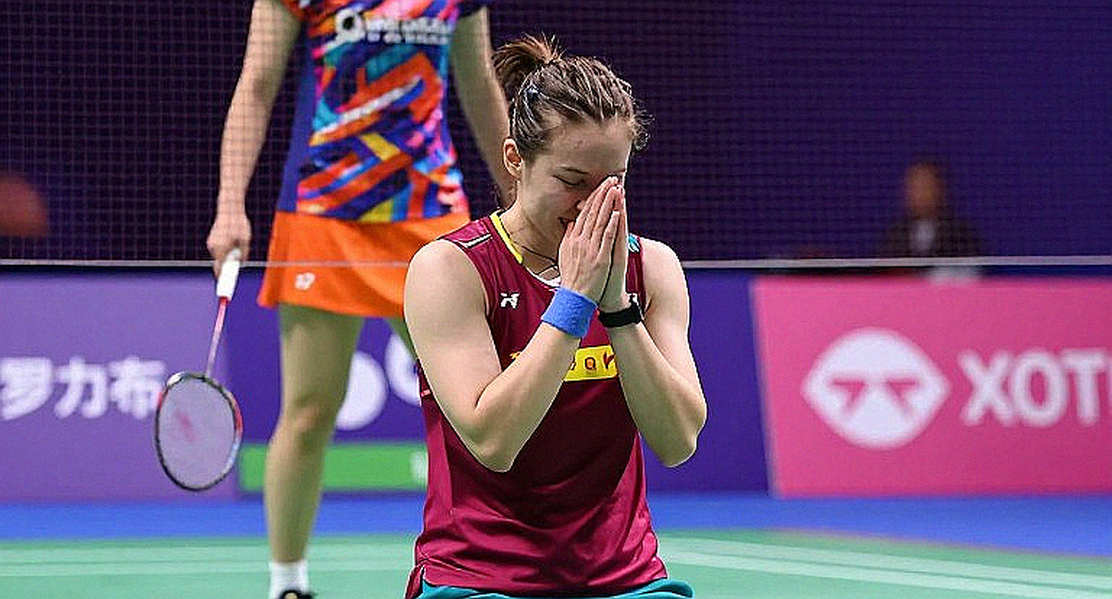
I am not saying last year's medal was fake. It was real. But before using it as a basis for this year's projection, the environmental contribution must be subtracted.
On the leadership side, BAI General Secretary Sanjay Mishra offered a sequence of morale-oriented statements: India has a strong chance, the team has good momentum, the players have worked extremely hard, and the squad is confident. That is public-relations messaging, not analysis. It says nothing about the new format, nothing about Indonesia, nothing about playing away. In my work, I file statements like that under low technical reliability and high intentional reliability.
There is one more information gap I must flag, and flag clearly. The announcement names only India, Indonesia, Peru, Brazil, Macau China and Senegal. The traditional junior badminton powers of Asia do not appear. That could mean they sit in unnamed groups, and it could mean they are absent. The announcement does not let us separate the two. Reading an incomplete list as if it were complete is a basic analytical error, and I will not make it.
Contrarian angle: correlation is not causation
The story Indian media is telling looks like this: a talented junior generation, led by an Asian U17 champion, building on last year's historic medals and heading for a breakout in Cairo.
That story has three links, and each needs separate testing.
The first link is the causal attribution between U17 success and U19 prospects. There is a correlation between winning at junior age groups and succeeding at higher levels. But correlation is not causation, and it weakens considerably as the age gap widens. To win a global U19 title, a player needs matured physical capacity, the ability to absorb long rallies, and experience against opponents who have already played at adult level. A U17 title proves that player is better than peers. It does not prove readiness for the tier above.
The second link is the causal attribution between momentum and future results. The release uses the word momentum. Momentum is a psychological concept, not a statistical variable. In my data across multiple seasons, the momentum effect has a very small coefficient once opponent quality is controlled for, and roughly zero when the format changes. With two new formats in Cairo, the momentum variable loses almost all explanatory value.
The third link is the causal attribution between institutional investment and short-term results. India has a clearly organised junior pathway: the National Centre of Excellence in Guwahati, formal trials, a dedicated camp. Those are good signals, and they predict senior national-team depth three to five years out. But they predict at system level, not at the level of one tournament's result in October.
I do not believe in an invisible hand, only in models that can be verified. And the verifiable model here says one thing: India has a balanced squad, a favourable group path, an awkward play-off opponent, and a new format that raises upset probability for everyone.
There is another reading, the inverse of the optimism, that I consider more honest. If India fails to medal in Cairo, that does not disprove the progress of Indian junior badminton. It only disproves the assumption that home and neutral venues are the same variable. Conversely, if India medals in Cairo, that will be far stronger evidence than the Guwahati medal, because it removes the crowd variable.
And there is a third reading, the one I find most concerning. In a compressed, segmented format, a team with better depth but less experience of the new format can lose to a thinner team that has trained for it specifically. If the camp from September 25 to October 2 does not specifically simulate the 3x55 and 3x15 systems, India enters the tournament with a paper advantage and an on-court disadvantage. This is an unobserved variable, and it may be the decisive one.
A recorded defeat is worth more than a hundred guessed victories. If Cairo ends below expectations, I will file it under data, not disappointment. The question to answer after the tournament is not whether India has talent. The question is whether its system can adapt to a new ruleset faster than other systems can.
What to track
Without the noise, a match reveals its skeleton. The skeleton of Cairo 2026 has five joints, and I will track all five.
The first joint is the official document defining the 3x55 mechanics. Until it is published, every tactical reading of the team event is a labelled hypothesis.
The second joint is the Group D1 result. If India fails to top a group containing Peru and Brazil, the emergence narrative has to be rewritten from scratch.
The third joint is the play-off against the Group D2 winner, almost certainly Indonesia. A single knockout tie, in a new format, between two teams four seeding places apart. That is a coin flip with some skill attached.
The fourth joint is the actual minutes played by Yogansh Singh and Aanya Bisht. If they go deep in both events, we get a case study in junior workload management that world badminton currently lacks data for.
The fifth joint is the full entry list. If the traditional junior powers appear in groups that were not mentioned, the true difficulty of the draw is far higher than the announcement suggests.
India is entering a tournament where the rules have changed, the home court has vanished, and the gap to its direct rival is four seeding places. Data is quieter than belief, but it never equivocates. After October 17, we will know whether the story of a rising generation is a trend, or just a season played at home.