
5-0 and 0-5: Two Faces of the Kata Scorecard at the Asian Games in Japan
**Câu trả lời cốt lõi (≤60 từ):** Đội kata nữ Việt Nam gồm Nguyễn Thị Ngọc Trâm, Bùi Ngọc Nhi và Hoàng Thị Thu Uyên giành huy chương vàng đồng đội tại đại hội thể thao châu Á tổ chức ở Nhật Bản, thắng Iran với tỷ số giám định 5-0. Bùi Ngọc Nhi thêm huy chương đồng kata cá nhân; Nguyễn Thị Diệu Ly giành huy chương đồng kumite hạng 68 kg. Toàn bộ dữ kiện chưa được đối chiếu với bảng kết quả chính thức của WKF. **Dữ kiện chính:** - Đội kata nữ Việt Nam thắng chung kết trước Iran với tỷ số giám định 5-0, không giám định nào phản đối. - Bùi Ngọc Nhi thua 0-5 trước võ sĩ chủ nhà Nhật Bản ở kata cá nhân, sau đó giành huy chương đồng. - Nguyễn Thị Diệu Ly giành huy chương đồng kumite hạng 68 kg; nguồn không nêu chi tiết chiến thuật. - Mức thưởng nêu trong nguồn là khoảng 1,2 tỷ đồng, chưa rõ là tổng đội hay theo từng vận động viên. - Địa điểm được nêu là Nhà thi đấu Toyohashi, Nhật Bản; đây là tấm huy chương vàng đầu tiên của đoàn Việt Nam. **Nguồn:** Bản tin tổng hợp không xác định được cơ quan báo chí, không có ngày xuất bản, mọi điểm thông tin đều ghi nguồn là không có. Không thể đối chiếu chéo với cơ sở dữ liệu VuaBong.vn do thiếu nguồn gốc kiểm chứng được. **Hỏi đáp liên quan:** Q: Tỷ số 5-0 trong kata có nghĩa là gì? A: Theo cách ghi của nguồn, đó là năm giám định cùng chọn một đội, phản ánh mức đồng thuận chứ không phải khoảng cách điểm số. Q: Vì sao cùng một đoàn lại có cả 5-0 và 0-5? A: Vì kata đồng đội và kata cá nhân là hai nội dung chấm độc lập, và nội dung cá nhân gặp võ sĩ chủ nhà Nhật Bản. Q: Karate còn trong chương trình Olympic không? A: Karate chỉ xuất hiện tại Tokyo 2020 và đã bị loại khỏi chương trình Paris 2024, điều này giới hạn trần tài trợ và phủ sóng của môn.
Toyohashi, Japan. The tatami was polished to the point of mirroring the overhead lighting rig. Three Vietnamese female athletes walked out, formed a line, the distance between them measured by eye rather than by tape. Nobody threw a strike. Nobody fell. No blood, no collision, no passage of play to rewind ten times.

And yet I sat in front of the screen, palms flat on the desk, my heart beating at exactly the rhythm I have felt on nights waiting for a VAR decision to be announced. The first whistle was blown by the camera, and I heard it as though the whole world were holding its breath.
Because in kata, the thing that decides everything sits off the mat. It sits in the eyes of five people in the row opposite. When the flags went up together, the result appeared: 5-0. Not a single judge dissented. Against Iran, Vietnam's women's team kata won the final on absolute consensus.
Then, a short while later, in the individual event, the flags went up in the opposite direction: 0-5. Bui Ngoc Nhi lost to the host Japanese athlete without taking a single judge's vote. Same event, same mat, same scoring system. Two entirely opposing outcomes.
That is why I want to spend this article on a question that sounds simple: when there is no frame to review, who is the final scorer?
The rulebook audiences tend to skip
Competitive karate under the World Karate Federation (WKF) comprises two disciplines that are fundamentally different in nature. Kata is the form discipline, a choreographed sequence performed individually or by a team of three, scored by a panel of judges on technical precision and athletic quality. Kumite is point-based sparring, where athletes score yuko (1 point), waza-ari (2 points), ippon (3 points), or win by taking an eight-point lead.
Put plainly: kata has no knockout. No finishing blow, no extra round, no blood. A technically clean kata that drifts a quarter-second off rhythm at the twelfth movement can still lose points, and outside the three people seated on the judging panel, almost nobody in the hall notices.
That is what I always want fans to grasp before they argue about a medal. In football you have VAR, you have frames, you have lines drawn on a screen, you have a three-person VAR team in a sealed room at the operations centre. In kata you have nothing but an eye trained over years and a standard held in the head. Every argument about kata is therefore an argument about belief, not about data.
This edition of the Games took place in Japan, the country that gave birth to karate, where kata is treated as the root rather than a side event. The Toyohashi Gymnasium. Vietnam's sports delegation took its first gold medal of these Games in the women's team kata.
According to the source, the team comprised three athletes: Nguyen Thi Ngoc Tram, Bui Ngoc Nhi and Hoang Thi Thu Uyen. Alongside the team gold, Vietnamese karate also brought home two bronzes: one in the individual kata of Ngoc Nhi, one in the 68 kg kumite of Nguyen Thi Dieu Ly.
One detail must be stated up front: according to the article, this was a successful title defence, because the same trio had won that very title at Asiad 19 in Hangzhou. If that is right, we are talking about a multi-year peak sustained across a full cycle. If it is wrong, the entire defending-the-throne frame has to be rewritten. I will return to this point at the end.
When five flags go up together
A 5-0 scoreline in a team kata final means something very different from the sense of a crushing win that football fans are used to.
In football, 5-0 is a match in which the winner destroyed the opponent in chances, possession, shot count, quality of final action. In kata, that scoreline says exactly one thing: five independent judges, seated in five different positions, looked at the same performance and reached an identical conclusion.
In other words, 5-0 is a statement of consistency. It does not measure the gap in level between Vietnam and Iran; it measures the degree of consensus on the judging panel about which team performed better across two or three short minutes on the mat.
Based on my own experience of watching kata bouts at both regional and international level, team kata is scored on three separate axes that spectators usually merge into one: the technical accuracy of each movement, the synchronisation of three bodies, and athletic intensity, meaning the tension, the decisiveness, the compression of force at the end point of every movement.
Of those three, synchronisation is the most fragile and the hardest to repair. It does not matter how good three athletes are individually if, at the seventh movement, one drops their hips a tenth of a second later than the other two. No camera at normal speed catches that. Only an eye seated at the right angle does.
The fact that a trio held synchronisation high enough that not one of five judges objected, in a final, on the mat of the country that owns this sport, is a purely technical outcome. It is not luck. Luck does not hold the consensus of five people whose profession is judging forms.
But I have to add something the original article does not mention: the 5-0 notation is unusual against the WKF's current kata scoring system. The modern system typically uses technical and athletic points awarded independently by multiple judges and then aggregated, rather than a flag-count format resembling a vote. There are two possibilities. One, the media simplified the result for readability. Two, the competition used a variant.
As someone whose trade is looking at quantitative decisions, I lean towards the first. I am flagging it here so that the second half of this article has something to stand on.
When five flags look away together
Then came the 0-5.
If 5-0 measures consensus, then 0-5 measures consensus in the opposite direction. What stands out is that both results belong to the same delegation, in the same tournament, on the same mat, differing only in team versus individual event.

Here is one variable I cannot ignore: the opponent was a host-nation Japanese athlete.
In any sport judged by people rather than measured by a clock or a tape, home advantage exists in one form or another. It is not necessarily cheating. It is something subtler: a full hall, applause landing on the right beat, familiarity with how the region judges, and most importantly, a culture that treats the discipline as national heritage.
Karate was born in Japan. Kata is its root. A Japanese athlete performing kata on home ground, before a home crowd, under the eyes of judges who grew up with this discipline, is playing at home in the deepest sense of the word.
A 0-5 result in those circumstances does not say Ngoc Nhi performed badly. It says the gap between her and the host athlete, in the eyes of the five people seated opposite, was a gap with nothing to argue about.
And this is where I want Vietnamese fans to be calmest.
It is precisely because she lost 0-5 in the individual event that Ngoc Nhi entered the bronze-medal bracket and claimed that bronze. A whitewash loss in an early round, in a knockout format with a repechage path, is not a full stop. It is another door opening.
What I find more noteworthy: Ngoc Nhi is the only athlete in this story who appears in two roles, as the anchor of the gold-winning team and as an individual bronze medallist. Across a multi-day Games, an athlete who both holds synchronisation with two teammates and stands alone before a judging panel in the individual event is undergoing no small physical and psychological test.
The bronze with no frame attached
Nguyen Thi Dieu Ly won bronze in the 68 kg kumite. And I have to be honest: this is the blurriest part of the whole picture, because the source provides not a single tactical detail.
Kumite is the only discipline in this article that can be analysed in the language of combat sports. It has distance, counters, rhythm management, scoring early and then protecting a lead. WKF rules allow a win by ippon, or by taking an eight-point lead, a mechanism close to an early stoppage in boxing.
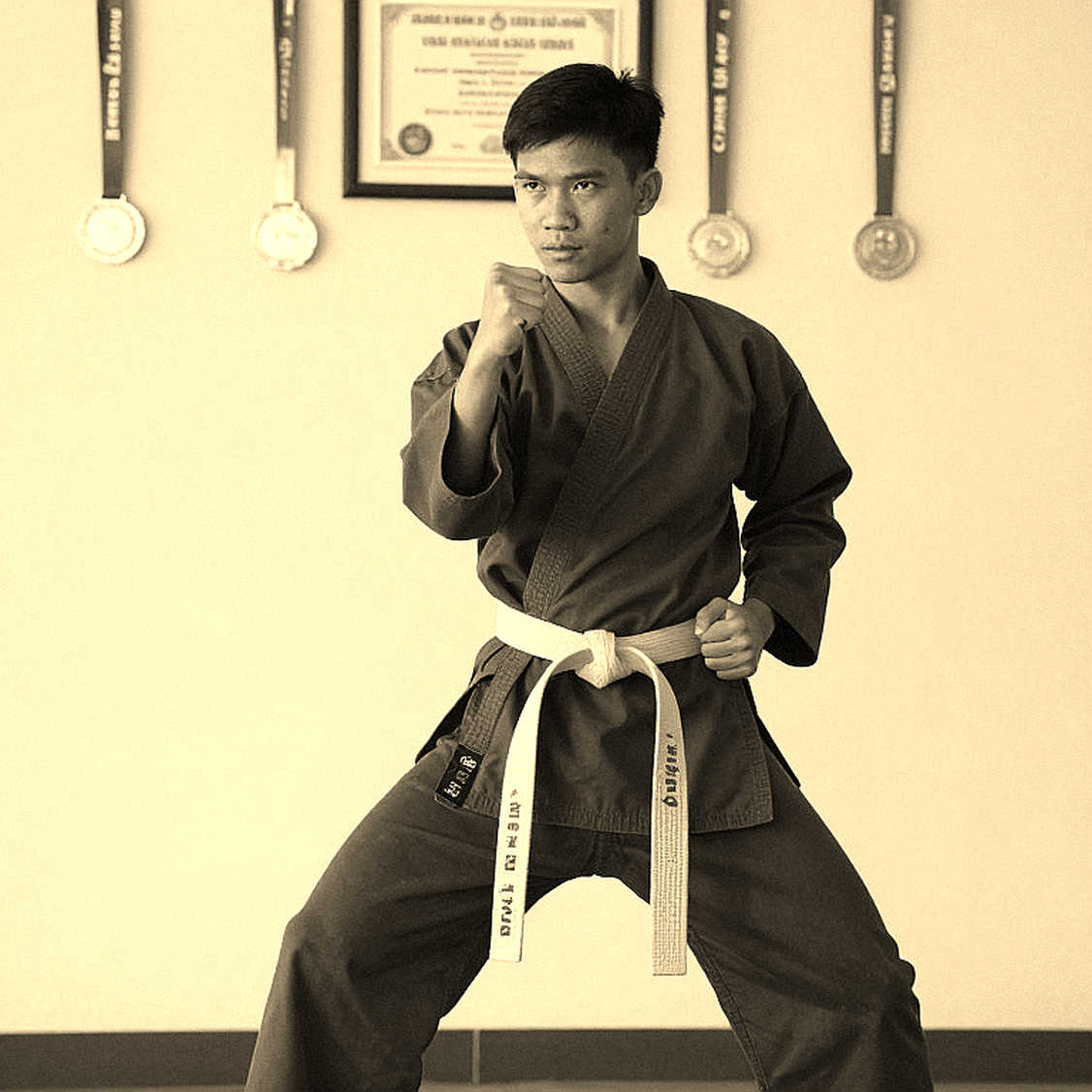
But nothing in the source says which bouts Dieu Ly won, by what score, where she lost, who her opponents were. As an analyst, I choose not to speculate. When there is no data, silence is a professional choice, not avoidance.
The only certain thing: this is the only weight class in the article that generates body-weight pressure. Kata has no weight classes, no weigh-in cuts, no six-a.m. scale. The 68 kg kumite does. Dieu Ly's cut magnitude is not stated, but it is the only variable in the entire story capable of affecting physical performance.
A gold medal that carries a whole system
Beyond the competitive result, the original article contains an economic datum worth isolating: a reward of roughly 1.2 billion Vietnamese dong for the gold-winning trio.
That figure needs careful reading, because it is ambiguous at precisely the point that matters most. If 1.2 billion dong is the total for all three athletes, each receives about 400 million. If it is a per-athlete figure, the total reaches 3.6 billion. Those two readings lead to entirely different conclusions about the scale of the incentive mechanism.
And at an exchange rate of roughly 25,000 dong to the US dollar, even the highest reading lands around 45,000 to 50,000 dollars for the whole group. Set beside any payout in professional sport, that is a very modest sum. Set beside the amateur baseline in Vietnam, it carries genuine weight.
Karate is governed by the WKF and delivered within a multi-sport Games framework run by the Olympic Council of Asia. There is no promoter, no pay-per-view broadcast rights, no individual endorsement deals of the professional-fighter kind. Athlete income comes from state budgets, medal bonuses, and occasionally corporate sponsor top-ups.
That structure explains why an Asian Games gold triggers ceremonial imagery: sports administrators greeting the team, flowers, embraces, smiles for the cameras. In an amateur system, national honour is the primary currency, and it is paid out in recognition rather than in contracts.
One structural detail matters more to me than the bonus itself: karate was dropped from the Olympic programme after Tokyo 2026, having appeared for exactly one edition. That imposes a ceiling on sponsorship value, on exposure, and on how budget planners view the sport in subsequent cycles.
Put another way, an Asian Games karate gold is prestige-rich and cash-poor. That is a structural feature, not a coincidence.
Where I do not fully believe it
At this point I have to say the thing anyone who reviews decisions for a living must say: everything analysed above rests on a single, unverified source.
Every datum here, from the 5-0 and the 0-5 to the three athletes' names to the claim of a successful title defence from Asiad 19 in Hangzhou, has yet to be checked against an official results ledger from the WKF or the Olympic Council of Asia. I do not want to hide that from my readers.
Two things bother me most on logical grounds.
The first is the kata score notation. A modern form-judging system operates on technical and athletic points from multiple judges, added and deducted, not as a show of hands. If 5-0 is media shorthand, it remains useful as an indicator of consensus. If it is read as a literal vote, it misdescribes the discipline.
The second is the title-defence claim. It is the detail that raises the value of the story enormously, because it turns a single coronation into a sustained peak cycle. It is also the most easily verified and most easily wrong detail. If the trio stayed intact across multiple cycles, that signals selection stability and depth in the training programme. If not, the story reduces to a single result.
And here I want to return to something else, something I once did to myself: that semi-final night, I betrayed my own belief to embrace my heart. I once wrote a conclusion grounded in evidence, then softened it purely under pressure from an online community. I know that feeling. I know exactly where it leads.
So this time I am keeping what I wrote: a team kata gold on a unanimous score is a technically real result. The parts without evidence I leave as questions, not conclusions.
There is one more thing that anyone looking only at the medal table will miss: behind the two kata events and the kumite bronze sit three different selection mechanisms. Team kata needs a group that has bonded over years. Individual kata needs an athlete who can carry pressure alone before a judging panel. Kumite needs an athlete who can make weight and still fight multiple bouts in a day. A delegation that does all three well has a training programme that does not depend on one exceptional individual.
What to watch in the next cycle
When the contest closes and the medals are in their boxes, the audience's belief is broken into pieces again and reassembled by the audience itself through argument. Five thousand members, one old screen, and a belief split into five thousand fragments. That is how this sport actually runs.
For Vietnamese karate, the question of the next cycle is not whether the gold can be held. It is whether the coaching staff can keep that trio together long enough to turn a single coronation into a standard, and whether the current bonus mechanism is strong enough to retain athletes at the best age of their careers.
And if domestic karate organisers would publish detailed judge-by-judge scorecards, with technical and athletic points broken out separately, then arguments about kata would shift from arguing with emotion to reading numbers. A small step, but it changes entirely how fans trust a result.
The referee blows the whistle, but the fans are the ones who deliver the final score.